
AI MARKETING • March 2026 • 7 min read
AI in Marketing: What Actually Works (And What Doesn’t)
Artificial intelligence has been the most hyped topic in marketing for the past three years. Every software company, every agency, and every marketing conference has been telling you that AI will transform your business. Some of that is true. A lot of it is noise. In 2026, the hype is finally meeting reality — and the picture is more nuanced than the headlines suggest.
Here is an honest, research-backed breakdown of where AI is genuinely delivering results in digital marketing, and where it is still falling short.
What AI in Marketing Actually Does Well
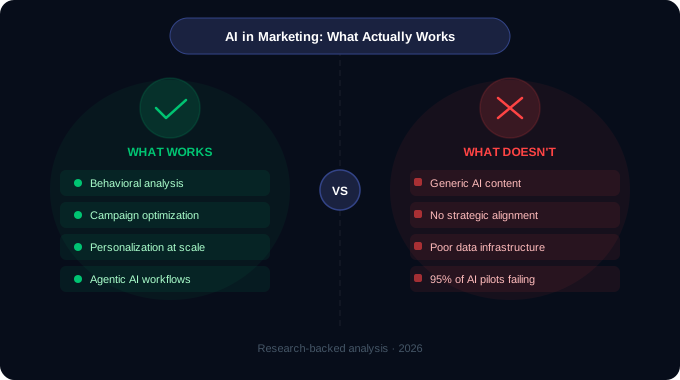
According to the IE Business School’s 2026 Digital Marketing Trends report, AI now sits at the center of how leading marketing teams plan and execute campaigns. Specifically, AI excels in four areas:
- Behavioral analysis: AI processes massive amounts of customer data — browsing patterns, purchase history, engagement signals — and identifies segments and patterns that humans simply cannot spot manually.
- Content variation and testing: AI can generate dozens of variations of an ad, email subject line, or landing page headline, then automatically test which versions perform best.
- Campaign optimization in real time: Instead of waiting for weekly reports, AI systems monitor campaign performance continuously and adjust bids, targeting, and budgets automatically.
- Personalization at scale: Delivering different content to different audience segments, based on their behavior and preferences, has historically been manual and time-consuming. AI makes it automatic.
The ‘Agentic AI’ Shift
The biggest AI development of 2026 is what Gartner calls ‘Agentic AI’ — autonomous systems that do not just assist marketers but can independently execute multi-step campaign workflows. Agentic AI can analyze performance data, adjust targeting, generate new creative variations, coordinate across platforms, and adapt in real time, all without constant human input.
💡 Gartner predicts that AI agents will take over many routine customer engagements — from notifications to reorders to personalized guidance — shifting marketing from channel-based execution to fluid, autonomous, agent-driven journeys.
This is not science fiction. Early adopters are already using agentic AI to run what previously required entire campaign management teams.
Where AI Falls Short
Here is where we have to be honest: AI-generated content at scale is creating a serious problem. Smart Insights’ 2026 report points to a massive rise in what they call ‘AI slop’ — generic, lifeless content produced at volume by AI tools that lacks the specificity, voice, and genuine insight that audiences and algorithms reward.
MIT research cited by Smart Insights found that 95% of generative AI pilots are failing to deliver measurable business value. The reasons? Lack of strategic alignment, poor data infrastructure, and weak integration with actual business goals.
Even more telling: Gartner notes that consumer-facing AI shopping agents are seeing very limited adoption because people simply do not trust AI to make purchasing decisions on their behalf. Human judgment, relationships, and trust remain essential — especially in high-consideration purchases.
The Right Way to Use AI in Your Marketing
The businesses winning with AI in 2026 are not the ones replacing their marketing teams with AI tools. They are the ones using AI to amplify what skilled humans do best. Use AI for the time-consuming, repetitive, data-heavy work. Keep humans in charge of strategy, brand voice, creativity, and client relationships.
At TechHypeStudio, we use AI to supercharge our research, optimize our ad campaigns, and analyze performance data — while our strategists and creatives focus on the work that actually requires human intelligence. It is a combination that consistently outperforms either approach alone.